The Unterschlupf association is a specialized shelter for victims of violence, recognized at cantonal level. In accordance with the Law on Assistance to Victims of Crime (LAVI), people affected by violence are entitled to free advice and support from an official victims' advice center. At the same time, the Unterschlupf association offers protective accommodation to people affected by domestic violence.
We are involved in specialist working groups and commissions. Through our public relations, prevention and awareness-raising work, we are committed to combating domestic violence and supporting women, men and children who are victims of violence. We carry out projects, offer training on a range of specialist topics and give talks to associations and schools.
30 years ago and more, behind the facade of an intact family, there was a state of emergency for women victims of partner violence.
When a group of socially and politically committed women founded the Unterschlupf association on November 30, 1993, their mission was to provide a place of welcome and shelter for women victims of violence.
Founding members: Sr Christophora (president), Stucky Alice (vice-president), Zehnder Lea (secretary), Kronig Anna (cashier), Näpfli Philipp, Imhof Daniela and Hauser Brigitte (assessors)
The creation of the association was preceded by two years' work on the project. A specially commissioned "(K)ein Tabu" study ascertained the extent to which the subject of domestic violence and marriage was perceived in the Upper Valais, and the degree of acceptance of a regional women's shelter
Aware of the lack of acceptance of a women's shelter in the region, and due to a lack of financial resources, a decentralized model for a women's shelter was developed, which still exists today.
With several accommodation options spread throughout the Upper Valais, Unterschlupf is not a women's shelter in the classical sense of the term. And yet, with its range of services, it meets the requirements of the catalog of services offered by women's shelters in Switzerland, and has been a member of the umbrella organization for women's shelters in Switzerland and Lichtenstein since 2004.
The refuge has always been more than a women's shelter. Indeed, the primary objective was to counsel women victims of violence so that they could free themselves from abusive situations. The shelter offered protection and was seen as a transitional solution.
When the association was founded in November 1993, no one had any idea that the Federal Law on Assistance to Victims of Crime, enacted the same year, would have a decisive influence on the development and fate of the shelter.
Sociopolitical developments and their legal underpinnings:
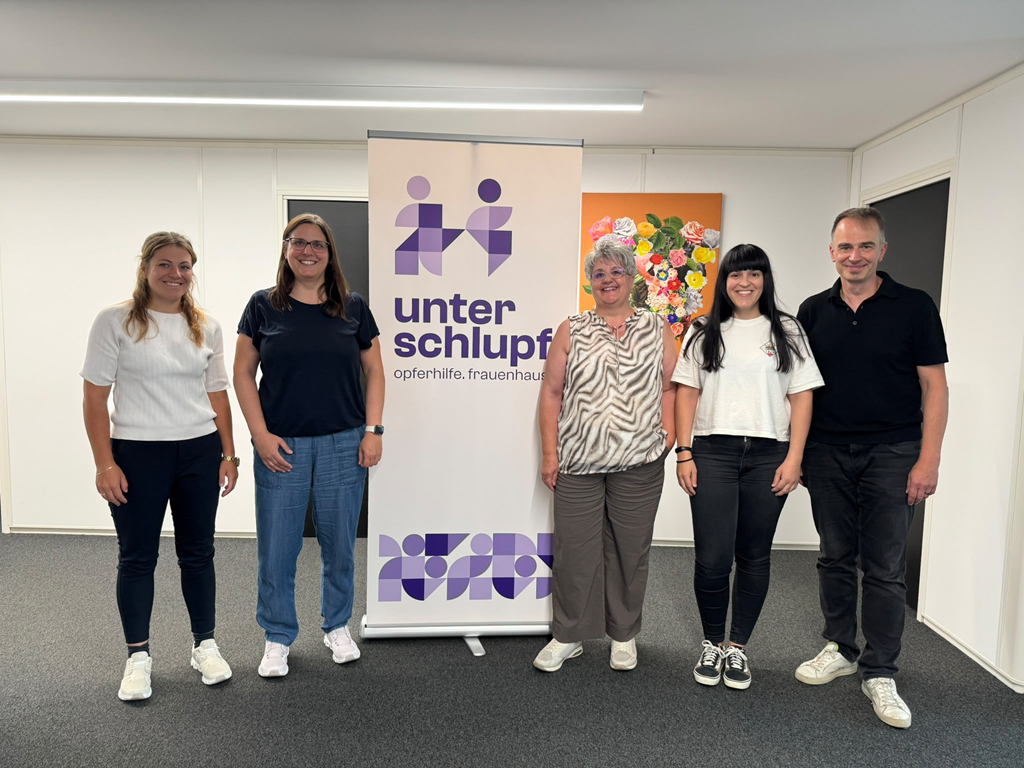
The Executive Board consists of five members: Sandrine Volken, Medea Marx, Irmina Imesch-Studer, Anja Zehnder and Christian Bayard (Chair).
We are funded through service contracts with the canton, membership fees and donations.
The department is managed by Céline Salzmann, social educator.
The current team consists of 7 professionals with basic training in social pedagogy or social work. All the women on the team have specialized training in victim counseling.
We currently have no vacancies.
The Unterschlupf association is always dependent on donations for its work in women's shelters. We would like to thank all our donors for their support and assure them that the donations received will be used exclusively for the people concerned.
We would like to thank all donors.
You can support the association in the following ways: